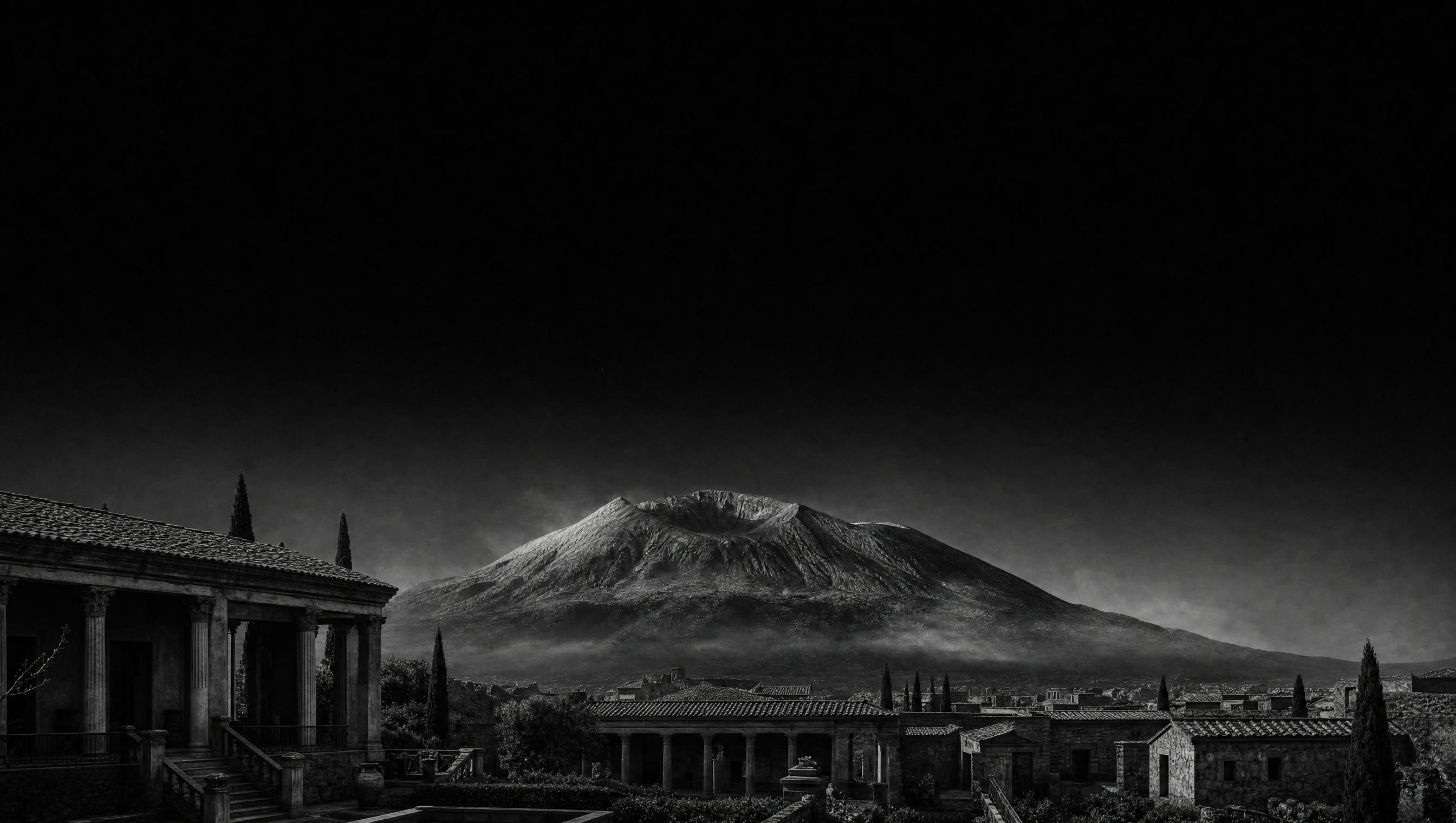
A library stood beneath this mountain.
The Vesuvius Challenge
Beneath
Vesuvius.
I am building a research system to recover writing from ancient scrolls that cannot be physically opened.
Then the sky became ash.
The buildings disappeared. The scrolls became carbon.
Two thousand years later, X-rays let us enter.
Now I am building a way to tell real writing from a convincing mistake.
The challenge, in plain English
Read the page.
Never touch the scroll.
Mount Vesuvius buried Herculaneum and its private library. Heat turned hundreds of papyrus scrolls into fragile, tightly wound blocks of carbon. Together, they form the only intact library to survive from the ancient world.
Unroll one and it can crumble. The Vesuvius Challenge asks us to read the writing digitally: scan the sealed object, reconstruct a page inside it, and detect ink without ever opening the scroll.
01 / 03
Capture the sealed scroll as thousands of X-ray slices.
Think of a medical CT scan, but detailed enough to see a single sheet of papyrus.
Follow one crushed sheet, then lay it flat on screen.
Software separates the page from hundreds around it and traces every fold without opening the physical scroll.
Search the flat surface for the physical trace of ink.
The model can propose a mark. The evidence still has to prove that the mark is real.
The first discovery
Confidence can
look like writing.
Different ink models highlighted the same places. At first, agreement looked like confirmation. Under closer inspection, the marks resolved into fibers, seams, torn edges, and the natural grain of papyrus.
Reproducible does not mean true.
The pivot
Stop asking what
looks like a letter.
Ask what would still be true if the letter disappeared.
Start on a scroll where experts have published the answer.
If the system cannot recover known writing, it has no right to approach an unread scroll.
Connect each character to an exact place on the flattened surface.
No loose visual resemblance. Every mark gets a location that another researcher can inspect.
Trace that surface point back into the original X-ray volume.
The claim has to remain connected to physical papyrus, not just a convenient image.
Chance tests, blank regions, alternate masks, and independent review can all stop the result.
Only a result that survives those challenges moves forward.
What survived
the challenge.
The strongest result was not a new letter. It was a research foundation that became harder to fool.
Published writing traced back to the original scan.
PHerc0139 connected known characters to exact surface coordinates and their parent CT volume.
The PHerc1667 chain rebuilds end to end.
Every hash checks. The same renderer output can be rebuilt from its pinned source and binary.
Render geometry explained what first looked like ink.
All five PHerc1447 leads failed the frozen structural test, so none moved forward.
Cohors Vesuviana
A research system
built to disagree.
Romulus runs one continuous cycle. Six independent roles challenge the plan before a result is allowed to stand.
OperatorRomulusFrames the question, routes the work, verifies the receipts, and returns one accountable recommendation.
Minerva
StrategyChooses the next question and defines what a useful answer would change.
Vulcan
EngineeringBuilds the machinery and records enough detail for every run to be repeated.
Veritas
FalsificationTries to break the claim before the claim can move forward.
Mercury
IntelligenceTracks outside findings that can change the plan or shorten the path.
Plutus
CostProtects the compute, storage, and spend required to keep the work running.
Cassandra
RiskNames the failure modes early and keeps unresolved risk visible.
Live research · August 29, 10:48 PM
A stronger foundation.
One clear question ahead.
Five PHerc1447 leads
Every gap was explained by the renderer. Closing those false leads removed a major source of error.
STRUCTURAL_EXPLAINEDPHerc800 surface gate
The ruler failed before it touched the unread scroll, so no weak result was allowed through.
FAIL_METRIC_INVALIDPHerc1667 canonical chain
Every hash and coverage figure reproduces from the original scan. The daily research cycle is running again.
CANONICAL_CHAIN_PASSM1v2 offset scan
A live scan is testing whether the surface labels sit about 2.3 voxels away from the sheet center, the same scale seen by another Vesuvius team.
Offset profile in progress
ACTIVE · CPU · $0Why this matters
The failed gate may have exposed a real geometry property in the public surface labels. M1v2 is testing that explanation now. If it holds, it gives the field a better ruler before the next unread scroll is touched.
The methodology draft is ready for publication review.